
Your Complete Guide to the Introversion–Extroversion Spectrum Quiz
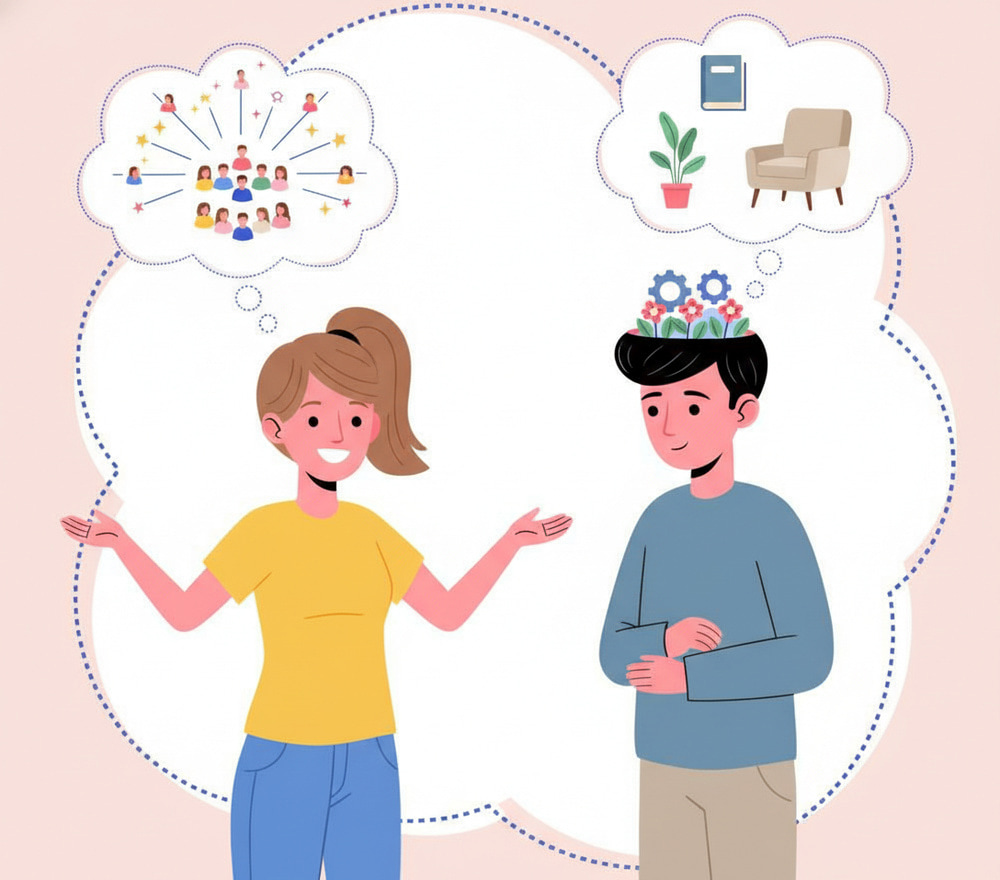
Introvert or Extrovert Personality Test
Get StartedWhy Personality Energy Matters More Than You Think
Most people feel their social energy change depending on context, time of day, and the demands of work or study. You might feel energized after a brainstorming session yet crave solitude to finish deep work, or you might light up in a lively group but fade during long solo tasks. These experiences reflect how you manage stimulation, not how “social” or “shy” you are. Understanding this distinction rewires how you plan days, choose roles, and communicate across different settings. It also helps you avoid self-limiting labels by focusing on situations that amplify strengths and reduce avoidable friction. That shift can improve satisfaction, performance, and relationships in ways that feel both practical and humane.
Many tools promise clarity, but the ones that help most connect patterns of energy with predictable behaviors in meetings, downtime, collaboration, creativity, and decision-making. Many readers first encounter the introvert extrovert quiz while searching for a simple self-awareness checkpoint. Good assessments translate responses into patterns you can apply immediately, whether that means blocking focus time on your calendar or stacking social tasks when your energy is high. The goal is not to box you in but to design your day to work with your biology. When that happens consistently, you unlock more sustainable productivity and less decision fatigue.
How Quality Assessments Are Built and Why They Work
Reliable questionnaires use clear language, scenario-based items, and consistent response scales. They measure converging signals such as social stamina, preferred work environments, recovery needs, and sensitivity to stimulation. Instead of asking whether you “like people,” they target behaviors like how you prepare for a presentation or how you feel after back-to-back meetings. This makes the outcome more predictive of what will help you tomorrow morning, not just descriptive labels that feel clever but change nothing. The best instruments also distinguish context effects, such as how travel, sleep, or deadlines temporarily shift your tendencies.
If you prefer a straightforward, result-focused tool, the am i introvert or extrovert quiz format gives you a fast signal without dense theory. Under the hood, smart scoring looks for consistency across items while allowing for nuance, like enjoying parties but needing recovery afterward. Look for assessments that share how many items they use, how they score, and what each scale represents. That transparency makes it easier to trust the result and to spot when life circumstances, like burnout or new responsibilities, might be influencing your responses temporarily. When you retake later, you can see trends rather than treating your profile as fixed.
- Use assessments that explain their scales and interpretation ranges.
- Favor scenario questions over vague preference statements.
- Retest after major life changes to compare trends, not chase a fixed label.
Practical Benefits You Can Use Immediately
Clarity about your energy patterns turns into better planning, kinder teamwork, and sharper communication. You can stack tasks that match your current energy level, negotiate meeting formats that help you contribute, and design recovery routines that keep your edge without burning out. Managers can shape agendas to include both reflective input and live discussion. Creatives can batch ideation and editing. Parents and students can adjust study environments for silent focus or active collaboration. The payoff is momentum that feels earned, not forced, and relationships that respect different refueling styles.
Some prefer a narrower lens, and the introvert quiz caters to those who want to focus on energy conservation in quieter contexts. In practice this might translate to time-blocked deep work, asynchronous brainstorming before meetings, and lighter social calendars during intense projects. Benefits compound when you set expectations with others, because clarity reduces friction and creates predictable rhythms. You can also experiment with micro-habits, like five-minute breaks between calls, or scripted openers for networking, to smooth transitions. Over weeks, those micro-adjustments stack into noticeably better days.
- Design your day around focus peaks and recovery windows.
- Agree on collaboration rituals that let multiple styles contribute.
- Use small experiments to find low-effort, high-value adjustments.
How to Take an Assessment for Accurate, Actionable Results
Your answers are snapshots of typical behavior, not idealized versions of yourself. Respond based on what usually happens across average weeks, not rare bursts during vacations or crunch time. Answer quickly and honestly, without trying to “game” the outcome toward an identity you prefer. If you’re unsure on an item, think about your energy two hours after the situation, recovery patterns often reveal the truth more than in-the-moment excitement. Finally, take the assessment in a neutral mood and location, ideally after sleep and hydration, so temporary stress doesn’t color your responses.
For a side-by-side view of stimulation preferences, the introvert vs extrovert quiz can clarify how you recharge and where you shine. You can improve accuracy by turning off notifications, setting a timer, and treating the process as a short meeting with yourself. After finishing, jot down three specific situations where the result could help you change a routine this week. Then schedule those changes immediately so insight becomes behavior. In a month, evaluate what stuck and what needs refinement. That feedback loop is where the real gains emerge.
- Answer for typical weeks, not edge cases or idealized versions of you.
- Take it in a neutral mood and quiet space to reduce noise.
- Translate results into three small, scheduled experiments.
At-a-Glance Spectrum Guide You Can Use Right Away
Think of the spectrum as a dial rather than a switch. Your position suggests default settings for social bandwidth, work environments, and recharge needs, yet it will still flex with context. That’s why two people with similar scores may behave differently during travel weeks or high-stakes deadlines. The most useful step is mapping results onto visible routines: meetings, communication channels, creative sprints, and recovery activities. When the environment fits, your skills surface more consistently and with less self-coercion.
Before scanning the chart below, the are you introvert or extrovert quiz mindset helps you notice patterns rather than chase labels. Use the table to translate tendencies into small, testable choices you can implement this week. Keep the focus on energy alignment, not personality judgments, and you’ll avoid common traps like over-generalizing or excusing avoidable friction.
| Work/Life Area | Leans Introvert | Leans Ambivert | Leans Extrovert |
|---|---|---|---|
| Energy Source | Solitude, depth, calm | Mix of solo and social | Interaction, variety, buzz |
| Meeting Style | Prep docs, quiet think time | Prep plus live debate | Dynamic discussion, rapid exchange |
| Focus Blocks | Long, interruption-free | Moderate with breaks | Short, varied, collaborative |
| Recovery | Alone time, nature, reading | Solo then brief hangouts | Active socials, shared activities |
| Communication | Asynchronous, written | Hybrid channels | Real-time, spoken |
Use the grid to audit your week. Align one recurring meeting, one communication habit, and one recovery ritual with your tendencies. Reassess after two weeks and adjust the dials, not the identity. Small, compounding refinements are better than dramatic overhauls that you cannot sustain. Keep a short journal to track which changes yield noticeable ease or momentum.
Reading Results with Nuance and Applying Them Wisely
Labels are only useful if they help you design better days. Think in probabilities: you will usually prefer environments that match your energy profile, yet exceptions will arise due to goals, relationships, or novelty. If a result surprises you, look for contextual variables, sleep, workload, family obligations, that may have skewed your answers. Then rerun the assessment later to confirm whether the pattern holds. Either way, treat the output as a guide for experiments rather than a fixed identity.
If your answers cluster in the middle of the range, an extrovert introvert quiz might show overlapping tendencies that depend on context. People in this zone benefit from modular schedules that include both social sprints and quiet recovery blocks. They may also adopt flexible collaboration rituals, like sending pre-reads before live discussions or pairing meetings with dedicated reflection time afterward. The key is designing rhythms that make switching costs lower and recovery reliable.
People who flex between both ends will value an introvert extrovert ambivert quiz that recognizes fluidity instead of forcing a binary result. These individuals can rotate roles on teams, facilitator one week, synthesizer the next, so the workload fits the current energy setting. They also tend to thrive with explicit boundaries around notifications and calendar buffers. Over time, that clarity prevents the energy “leaks” that lead to avoidable burnout.
Putting Insights to Work in Teams, Relationships, and Growth Plans
Teams move faster when they match meeting formats to energy diversity. Start with prep materials, add a tight live discussion, and finish with written decisions. Managers can assign roles that play to strengths, some people synthesize quietly, others ideate aloud. When you plan your week, place social tasks after sleep and workouts to boost stamina, and protect deep work before lunch. When you want a quick heuristic for meetings and networking, the am i extrovert or introvert quiz can point you to tactics that match your energy budget. Those tactics might include batching calls, using async updates, or committing to shorter, more focused workshops.
Partnerships also benefit from shared language about stimulation. Couples can trade off hosting and quiet nights, and friends can set clearer expectations for event length or seating arrangements. Couples navigating social calendars often look at an am i introvert extrovert or ambivert quiz together to balance stimulation and downtime. To turn insight into action, agree on “energy-safe” defaults like leaving events on time, building buffer days after travel, and using signals to pause when overstimulated. In professional development, align courses and communities with your stamina profile so practice feels natural rather than draining.
- Choose collaboration rituals that include both quiet synthesis and live exchange.
- Stack social work after rest; protect deep-focus blocks before interruptions.
- Make shared “energy agreements” with partners, friends, and teammates.
Common Pitfalls, Myths, and How to Avoid Them
One frequent mistake is treating the spectrum as a moral scale, as if one style is better for leadership or creativity. In reality, both ends generate value in different ways, and teams need the full range. Another error is ignoring context shifts such as sleep debt, travel, or illness that temporarily change how much stimulation feels good. Some people also confuse shyness or social anxiety with energy preferences, which leads to unhelpful self-talk and poor strategy choices. The antidote is to focus on situational design and skill-building, not identity policing.
If you’re exploring depth within the quieter end of the spectrum, a what type of introvert am i quiz reveals patterns such as social, thinking, anxious, or restrained styles. Even then, avoid locking into a single label; use it as a prompt to experiment with recovery, communication, and boundaries. Reassess after major life changes and compare outcomes over time. Keep notes on which adjustments improve mood, output, and relationships, because your lived data trumps generic advice. Above all, remember that sustainable growth comes from alignment, not force.
FAQ: Quick Answers to Popular Questions
How accurate are these assessments?
They’re as accurate as the clarity of the items, the honesty of your responses, and how stable your current circumstances are. Good instruments measure behaviors and recovery patterns rather than vague preferences. Retest after life changes to see trends rather than chasing a perfect, static label.
Can my result change over time?
Yes, especially with shifts in sleep, workload, environment, and skills like boundary-setting or facilitation. Your baseline tendencies remain, but better design and recovery can expand your comfort zones and reduce the cost of switching between collaboration modes.
How should parents and teachers introduce this topic to young people?
Use concrete examples, simple scenarios, and short questionnaires that tie behaviors to energy. Parents and teachers seeking age-appropriate language can adapt an introvert extrovert quiz kids approach with short prompts and concrete examples. Keep the focus on kindness, boundaries, and practical strategies rather than labels.
What if I land right in the middle?
Design modular routines that include both social bursts and quiet recovery. Plan buffers between meetings and deep work, and rotate roles on teams so you can contribute in ways that fit your current energy setting without overextending.
Should I share my result at work?
Share it if it will improve collaboration and reduce friction, and pair it with specific requests such as pre-reads or shorter live sessions. Framing your insight as a workflow preference helps colleagues respond constructively.
Conclusion and Next Steps
Your best work and relationships flourish when your daily design matches your energy realities. Treat assessments as maps for experimentation, not fixed identities. Use them to choose communication channels, plan recovery, and shape meetings that unlock your strengths. Then, run small experiments, review outcomes, and adjust dials over time. Consistency beats intensity when it comes to sustainable change.
Explorers who sense nuance among quieter profiles may enjoy a types of introverts quiz to refine routines, boundaries, and communication choices. Keep a simple log of what works, and revisit your plan after major shifts in schedule or responsibilities. Over months, the accumulation of small, energy-aligned decisions turns into a clear edge, more output, calmer days, and stronger connections built on mutual understanding.