
The Complete Guide to Personality Energy Styles and How to Harness Them
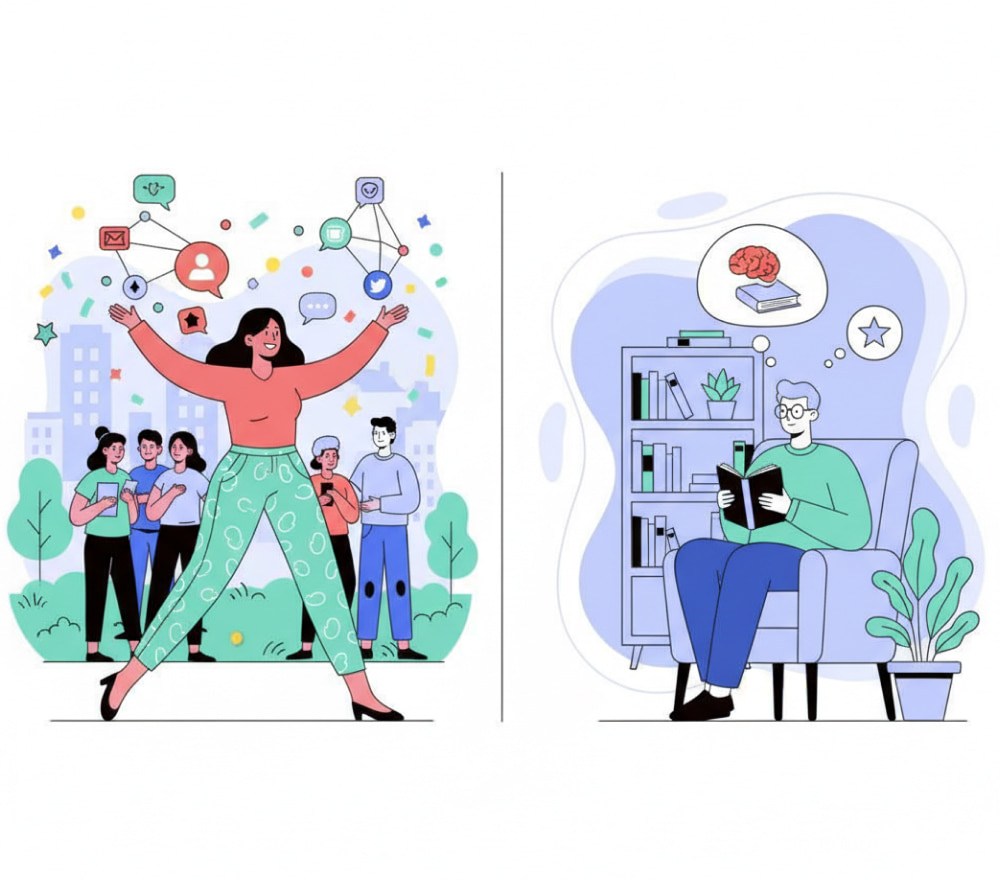
Introvert or Extrovert Personality Test
Get StartedWhat the Spectrum Really Means
People differ in how they gain energy, process stimulation, and choose their social environments, yet many assume personality is binary. In reality, the spectrum is fluid, context-dependent, and surprisingly dynamic over a lifetime. You might prefer quiet mornings, thrive in collaborative afternoons, and recharge alone in the evening, which complicates simple labels. That flexibility is normal, and it’s the reason self-knowledge requires nuance rather than rigid categorization.
Modern research highlights overlapping tendencies rather than hard walls, and our daily routines can nudge us along the continuum. Across articles and conversations, introvert extrovert ambivert shows up as shorthand for the entire continuum, but the useful insight is how your energy ebbs and flows with context. Instead of assuming fixed traits, consider situations that amplify your focus or drain your reserves, because patterns emerge when you watch them over time.
Culture, workload, and relationships all influence how your style expresses itself during the week. When people compare behavioral leanings, introvert vs extrovert vs ambivert becomes a useful frame for mapping differences without judgment, particularly when you separate internal motivation from outward behavior. That distinction helps you design days that honor your attention span, social appetite, and desired pace, which can dramatically improve decision quality and wellbeing.
- Think of energy like a budget that fluctuates with commitments and recovery.
- Track where your attention sharpens and where it scatters across tasks.
- Design days with intentional peaks, troughs, and buffers for renewal.
Core Traits, Misconceptions, and Context
Labels can clarify communication, but they can also oversimplify complex human patterns. Some people are talkative at work yet reflective at home, while others prefer the inverse, and both profiles can be equally healthy. Context, team norms, physical space, and the stakes of a decision, often determines whether your energy style is visible or hidden. Recognizing that fluidity prevents stereotyping and makes collaboration more humane.
In many teams, extrovert introvert ambivert labels can be oversimplified, yet they point to genuine patterns in energy gain and loss. The key is to treat them as descriptive snapshots rather than prescriptive rules. When designing collaboration norms, introvert ambivert extrovert perspectives all deserve equal weight to keep meetings balanced, brainstorms inclusive, and focus time protected. Consider how space, cadence, and social expectations shape participation and outcomes.
| Dimension | Introvert Tendencies | Extrovert Tendencies | Ambivert Tendencies |
|---|---|---|---|
| Energy Source | Solitude and depth | Interaction and variety | Situational mix |
| Communication | Deliberate and thoughtful | Spontaneous and verbal | Adaptive to audience |
| Decision Pace | Reflect first | Act then iterate | Switch based on stakes |
| Work Setting | Quiet, controlled | Dynamic, social | Hybrid, flexible |
| Social Battery | Limited without recovery | Extended with engagement | Expandable with breaks |
| Stress Signals | Overstimulation | Understimulation | Mood swings with context |
Misconceptions persist, such as equating sociability with confidence or quiet with disengagement. In practice, both depth and breadth are valuable: deep focus solves hard problems, while wide networks accelerate discovery. Teams perform best when they normalize multiple collaboration modes, silent idea generation, structured dialogue, and lively debate, so each person can contribute at full strength without masking their needs.
- Rotate facilitation styles to accommodate varied processing speeds.
- Publish agendas and decisions to support reflective contributors.
- Alternate between open discussions and written idea sprints.
Personal and Professional Benefits
Understanding your energy style pays dividends across career development, relationships, and wellbeing. Clarity lets you choose roles that are stimulating without being depleting, negotiate meeting rhythms that protect focus, and plan recovery that keeps you resilient. Partners, friends, and teammates benefit when you articulate needs early, because expectations align and friction fades. That alignment compounds over months into better performance and more ease.
For career clarity, am i an extrovert introvert or ambivert is a reflective question that can guide role selection and leadership style. You might emphasize quiet stewardship in high-complexity work or visible advocacy in stakeholder-heavy initiatives, and both paths can lead to excellence when chosen intentionally. In performance reviews, introvert ambivert or extrovert test insights can support strengths-based coaching when used alongside qualitative feedback, helping translate temperament into practical development plans without pigeonholing anyone.
Relationships also flourish when partners know how each person restores energy. One person may crave festive weekends, while the other prefers cozy evenings filled with books and music, and that contrast can be negotiated with care. Shared calendars, explicit “recharge windows,” and mutual rituals make the differences complementary rather than competitive, creating routines that feel fair to everyone.
- Negotiate communication windows that match each person’s peak energy.
- Design recovery rituals after high-stimulation events or deep-focus sprints.
- Use strengths language, depth, breadth, cadence, instead of labels alone.
Everyday Strategies to Thrive
Practical routines transform abstract insight into sustainable habits. Start by mapping your week: note when you feel expansive, when you crave quiet, and which tasks amplify or drain you. Block focus work near your natural concentration peaks, and cluster collaborative sessions when your social battery is highest. Small structural changes, like buffer time before presentations, can radically reduce stress and increase quality.
Before major decisions, ambivert test results are best treated as snapshots rather than permanent labels, and journaling helps you see what context might be skewing outcomes. To track growth over seasons, introvert ambivert extrovert test data can be logged with journaling to reveal contextual shifts, such as how remote work or new leadership changes your interaction preferences. Pair those observations with boundary-setting skills so you can say yes to energizing opportunities and no to unnecessary overload.
Build a toolkit that supports flexibility. Noise-canceling headphones, walking one-on-ones, and meeting-free mornings give you a dial to adjust stimulation. Meanwhile, social “bookends” like quick chats before deep work or reflection breaks after lively calls smooth your transitions and protect focus.
- Create a “menu” of recharge tactics you can deploy in five minutes or less.
- Batch similar tasks to reduce context switching and attention residue.
- Use calendar signals (icons, colors) to communicate availability and energy modes.
Assessments, Quizzes, and Responsible Use
Personality assessments can reveal helpful patterns, but they are best viewed as tools, not verdicts. Short scales capture tendencies; longer inventories offer nuance; reflection and feedback bring those results to life. The most accurate picture emerges when you combine self-report with observed behavior and iterate over time, because life stages and roles can shift your expression meaningfully.
For structured measurement, introvert extrovert ambivert test tools often rate energy focus, social preference, and stimulation thresholds, and reputable versions include reliability checks. When reflection feels lighter, introvert extrovert ambivert quiz formats can spark curiosity and nudge deeper self-discovery, especially when followed by a conversation with a mentor or coach. Use results ethically by avoiding labels as excuses and by seeking environments that celebrate diverse working rhythms.
To keep assessments useful, blend data with experimentation. Try a new meeting cadence for two weeks, then compare mood, output, and connection quality. Adjust based on evidence, not ego, and revisit your plan quarterly to account for changing demands at home and work.
- Prefer instruments with transparent scoring, validation data, and clear guidance.
- Retest only after meaningful context shifts, not every minor mood change.
- Pair results with goals, rituals, and boundaries that you can practice daily.
FAQ: Common Questions About the Spectrum
Is personality fixed, or can it shift with context?
Traits are relatively stable, yet expression often fluctuates with environment, stakes, and health. People can feel more social during creative sprints and more reflective when solving intricate problems, and neither state cancels the other. For casual exploration, ambivert quiz options can be a playful first step, but long-term patterns still matter more than any single snapshot.
How do I collaborate well with people who have different energy styles?
Agree on meeting purposes, publish agendas, and rotate facilitation so each processing style can contribute. Offer written channels for ideas, then synthesize in live discussions to balance depth with dynamism. Shared norms make differences complementary rather than competitive, especially when you protect recovery time after high-stimulation sessions.
What are signs I need to adjust my routine?
Watch for chronic fatigue, irritability after meetings, or restlessness during quiet stretches. These signals often mean your stimulation level is mismatched with your current tasks. Small changes, like reshuffling deep work to peak focus hours, can restore momentum and motivation quickly.
How should I use assessments without overrelying on them?
Treat scores as hypotheses to test in real life, combining them with feedback from colleagues and your own mood logs. If you want social-media-friendly phrasing, am i introvert extrovert or ambivert quiz queries often lead to interactive charts, yet your calendar experiments and energy journals will provide the most actionable insights.
Can my style help my career strategy?
Absolutely, because matching tasks to energy boosts performance and reduces burnout. Choose roles that align with your preferred cadence, advocate for meeting structures that support focus, and build recovery rituals. Over time, those choices compound into clarity, confidence, and sustainable achievement.
Conclusion: Design a Life That Honors Your Energy
Self-awareness about your energy style is a practical advantage, not just an interesting label. Build days that respect your attention, negotiate collaboration that suits your rhythm, and invest in recovery that keeps you resilient. With curiosity and iteration, you can combine depth, breadth, and flexibility into a personal operating system that elevates both wellbeing and results.
Curate environments that amplify your strengths, and keep experimenting as seasons change. Your best work emerges when stimulation, focus, and connection are intentionally aligned with how you naturally operate, and that alignment is a learnable skill.